
ATMOSFAR Cloud Cruiser Guide: Build, Power and Modules
How the ATMOSFAR Cloud Cruiser works: hull, reactor power, lift, fuel, material processor, plant beds, Wasp pads and the first modules to build.
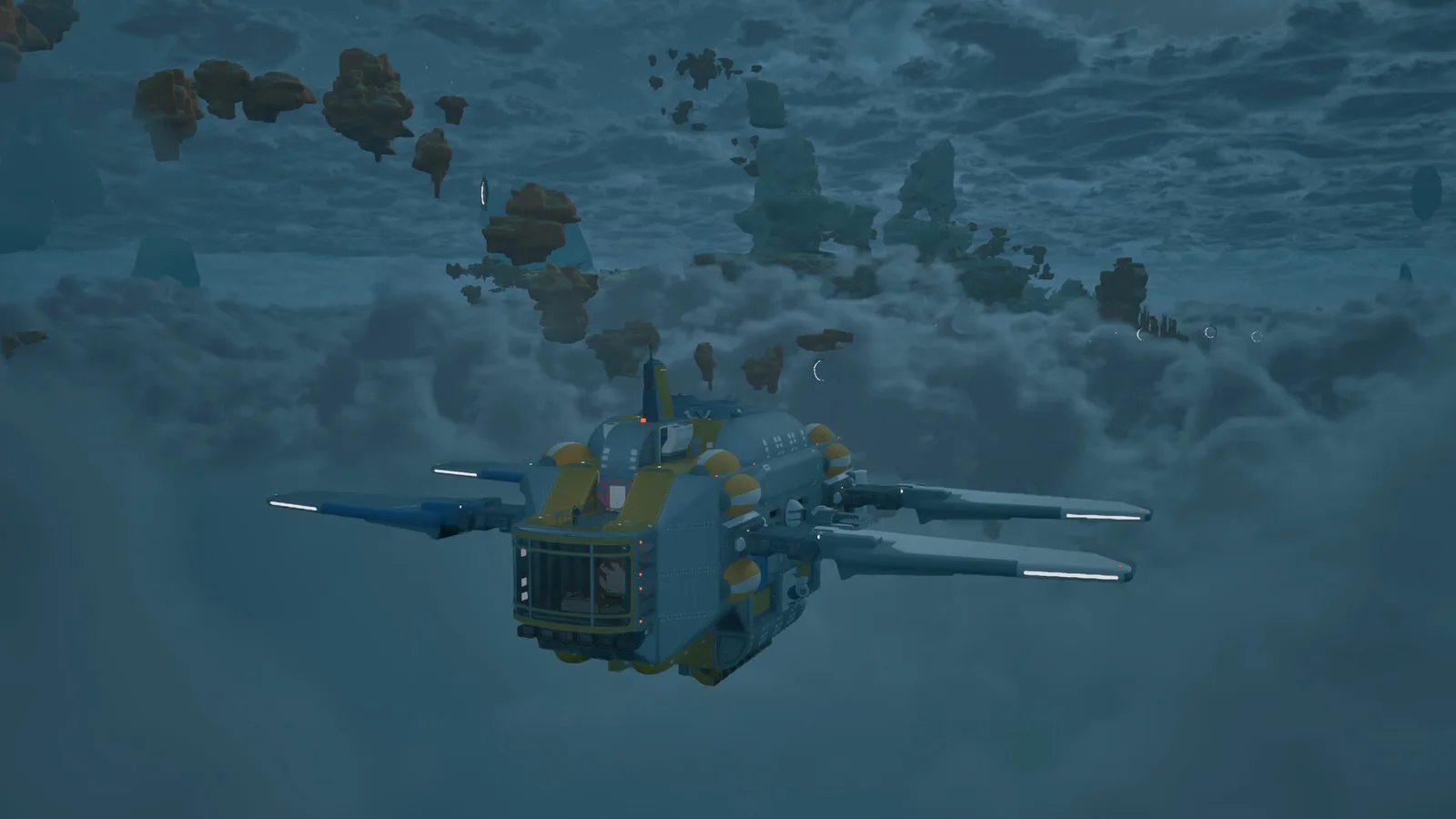
The Cloud Cruiser is a flying base, not a fighter. Its three budgets are power, lift and fuel, and every module you add spends at least one of them. Build the reactor and lift first, then the workshop, then the comforts.
The Cloud Cruiser is the centrepiece of ATMOSFAR. It carries your Wasp fleet, processes scrap you cannot handle on foot, grows food, refines fuel and moves your whole operation between islands. It is also the most common place for a run to stall, because the game lets you build a beautiful ship that cannot get off the ground.
This guide explains the systems in the order they matter.
Start with the three budgets
Every Cloud Cruiser decision is a trade between three numbers.
| Budget | What it pays for | What increases it | What drains it |
|---|---|---|---|
| Power (PU/s) | Lift, refinery, plant beds, charging, turrets | Nuclear reactor cores, more reactors | Every powered module, especially lift |
| Lift | Holding the hull and cargo in the air | Hydrogen balloons, more balloon volume | Hull parts, furniture, cargo, armour |
| Fuel | Thrust and Wasp operations | Hydrogen tanks, refinery output | Flying, cold storage of liquid hydrogen |
A ship that is heavy but under-powered will hover low, climb slowly and burn fuel fighting gravity. A ship with plenty of power but too little balloon volume will hit its lift ceiling with an empty cargo hold. Fix the weakest budget first; adding modules to a ship that is already failing one of them makes the problem worse.
Hull, interior and paint
The Cloud Cruiser is built from hull parts rather than a fixed blueprint. You choose the shape, place the parts, and tint each one. Interior pieces — windows, walls, doors, railings, ladders and stairs — let you lay out rooms, corridors and workspaces.
Two practical notes:
- Hull parts carry weight. A long decorative nose is not free. Check lift after every major addition.
- You can build while hovering. When you enter build mode around the ship, your jetpack connects to the Cruiser's fuel reserves by hose, so you can stay in the air indefinitely and build alongside co-op partners.
The ship is meant to be shared. In co-op, give each player a room or at least a bunk area; the game explicitly supports multiple jetpacks plugged in at once, and a four-person crew living in one corridor is a design choice you will regret.
Power: reactor cores are the bottleneck
The reactor is the heart of the ship. It burns uranium or plutonium fuel rods, uses the heat to make steam, and drives a turbine. Control rods set the power level.
- Reactor output is measured in power units per second. The development blogs use a 25 PU reactor as the reference example.
- Two reactors stack: two 25 PU cores give you 50 PU, at the cost of more cores, more fuel and more construction material.
- Reactor cores are rare, heavy and radioactive. They weigh hundreds of kilograms, and a bad drop can cause a large explosion. Use the Hauler's magnetic crane, not a hopeful push.
- The Scout Wasp's Geiger counter is the intended way to find cores, but the Scout is not in the launch build. Until the Rime update, cores come from exploration and story sites rather than systematic scanning.
If your ship feels weak, count generation before you add another turret. A 25 PU reactor with a refinery, lift system and three plant beds is already close to its limit.
Lift: balloons, not engines
The Cloud Cruiser stays up because of hydrogen-filled balloons, not because of thrust. The siphon feeds the balloons; the number and volume of balloons determine how much weight the ship can hold and how high it can climb.
- Adding hull sections, armour, cargo and furniture all raise the weight.
- When the ship is overweight, you get a warning. The fix is more balloon volume or less weight — not more throttle.
- Armour plates are useful against weather and hostile animals, but they are heavy. Armour the modules you cannot afford to lose, not the whole hull.
This is the part new builders underestimate. Engines make you go; balloons make you stay up. See the airship building guide for the weight-and-lift method.
Fuel: liquid hydrogen and cold storage
The Cloud Cruiser's thrust system runs on liquid hydrogen. Everything else on the ship runs on electricity. That split matters:
- Liquid hydrogen is stored at around -253°C. The fuel tanks consume power to stay cold. If the ship loses power, the fuel warms and evaporates.
- You can produce fuel two ways: an onboard hydrogen refinery fed with hydrogen crystals hauled from the surface, or an external hydrogen siphon that pulls hydrogen from the atmosphere and needs a steady power supply.
- The refinery is the higher-output option; the siphon is the lower-effort option. Most ships end up with both.
The full chain is in the hydrogen refinery guide.
Modules worth building, in order
| Module | What it does | Build it when |
|---|---|---|
| Reactor | Generates PU/s | Immediately; nothing else works without it |
| Fuel tanks | Store liquid hydrogen; consume power to keep it cold | Before your first long flight |
| Wasp pads | Dock, refuel and charge Wasps inside the ship | As soon as you own a second Wasp |
| Material processor | Breaks down scrap too large for the handheld extractor; can yield blueprints and remains | Before your first big wreck haul |
| Plant beds | Grow seeds into food and crafting materials; large seeds take a whole bed, small seeds up to four per bed | When food or organic materials become a bottleneck |
| Diagnostics unit | Reports power generation/use, fuel, lift, cores, docked Wasps and hull damage | Before long expeditions |
| Turrets | Manual or automatic stun defence against animals and drones | When you start parking near PACE sites |
| Cargo lift | Top opening and conveyor for loading and dumping cargo | Before bulk hauling |
Material processor
The handheld extractor has a size limit. Large hull sections and industrial wreckage need the processor, which is built inside the ship but accessed from outside by an escalator. The intended loop is: find a big piece, lift it with the Hauler, drop it at the processor entrance, and salvage the materials. Large pieces can also contain clues, blueprints and historical remains.
Plant beds
Seeds cannot be planted on the islands — the ground is floating rock, not soil. They go into plant beds on the ship. The beds run on power and handle watering automatically. Large seeds take an entire bed; up to four small seeds share one. Fruit feeds you or gives temporary buffs; some plants produce crafting materials.
Wasp pads
Each pad sits inside the ship behind a gate that opens to the sky. Fly in, land, refuel from the ship's tanks and charge from its power. Charging costs PU, so a full pad of drained Wasps is a real load on the reactor.
Defence and maintenance
- Turrets fire stun projectiles, not lethal rounds. Organic targets drop briefly; electronics such as PACE drones glitch out for a short time. They can be operated manually or set to automatic.
- Armour plates protect specific surface areas. They do not make the ship invulnerable, and they add weight.
- The diagnostics unit is the closest thing to a damage report. Use it before every long flight.
- Repairs use the welder and the required materials. If you want to move or remove a module, build mode has a demolish option.
A sane first expansion
- Reactor and enough balloons to lift the base hull.
- Fuel tanks and a refinery or siphon.
- One Wasp pad.
- Material processor.
- Diagnostics unit.
- Plant beds.
- Turrets and armour.
- Cosmetic hull work and extra rooms.
This order keeps the ship flyable at every step. If a step makes the ship unable to climb, stop and fix lift before continuing.
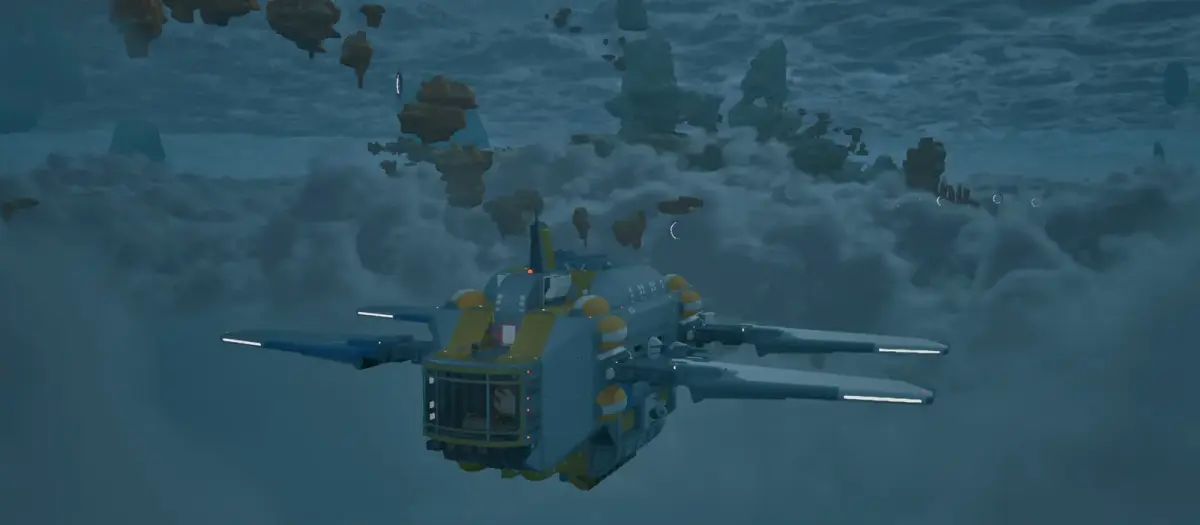
Early Access footage from Tycos. Screenshots: Apog Labs / SHUEISHA GAMES.
FAQ
Can you build the Cloud Cruiser from scratch? You start with a basic vessel and expand it. The hull is modular, so the final shape is yours.
Does the ship need fuel to stay in the air? Lift comes from hydrogen balloons and power. Thrust and manoeuvring use liquid hydrogen. A ship with empty fuel tanks can still float, but it cannot travel.
What happens if the reactor stops? Lift, refineries, plant beds and charging stop. Fuel tanks begin to warm. Keep a charged backup battery and a repair kit, and do not fly far from a landing site with a damaged reactor.
Can passengers build while the ship is moving? Build mode works while hovering around the ship, and multiple players can build at once. For long flights, finish structural work while parked.
Sources
- ATMOSFAR on Steam — store description, system requirements and Early Access notes.
- ATMOSFAR Steam news hub — patch notes and developer posts.
- ATMOSFAR official site — Apog Labs announcements and media.
Related reading: ATMOSFAR Airship Building: Hull, Lift and Weight and ATMOSFAR Hydrogen Refinery Guide: Fuel From Crystal.
Source note: mechanics and figures in this guide follow the Early Access build available on 30 October 2026, cross-checked against the ATMOSFAR Steam page and Apog Labs developer posts.
More ATMOSFAR Guides
The animals, plantimals and machines that end ATMOSFAR runs: Screechers, Blisterbacks, Traproots, PACE drones and AA turrets, with counters for each.
The ATMOSFAR Early Access roadmap: Vagabond, Rime, Blue Side and Singularity updates, the Scout Wasp, the third region, 1.0 timing and launch content.
Find ATMOSFAR hydrogen crystals near geysers, harvest them safely, haul them with the Hauler and turn them into liquid hydrogen before your Wasp runs dry.
Run an ATMOSFAR hydrogen refinery without draining your camp: power draw, cold storage at -253°C, field vs ship refining, siphon top-ups and common failures.
How the ATMOSFAR map works: the floating layers of Tycos, where Caligo Cays sits, what Early Access includes and how to navigate without a full map.
ATMOSFAR released on 29 October 2026 in Steam Early Access at $24.99, with a 10% launch discount to $22.49. Platforms, editions and what comes next.
A practical map of ATMOSFAR resources: scrap, circuit boards, hydrogen crystals, wood, food, water, artefacts and cores, with where to look for each.
An honest ATMOSFAR Early Access review: ship-building is excellent, the survival loop is coherent, and the launch build is still rough. Buy or wait?