
ATMOSFAR Hydrogen Crystals: Where to Find and How to Use
Find ATMOSFAR hydrogen crystals near geysers, harvest them safely, haul them with the Hauler and turn them into liquid hydrogen before your Wasp runs dry.
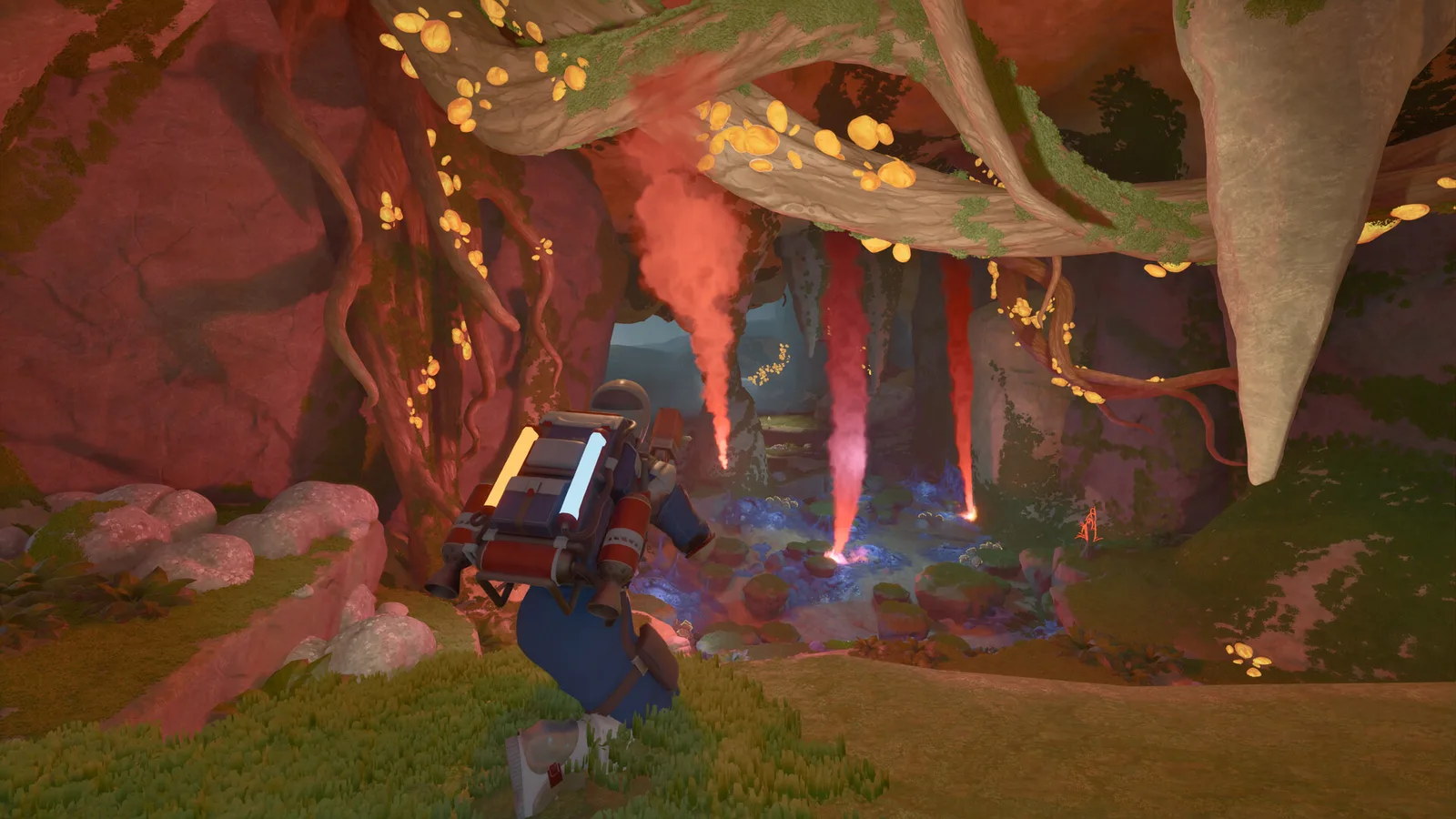
Hydrogen crystals grow around hydrogen geysers. They are the raw feedstock for liquid hydrogen, and liquid hydrogen is the only fuel your Wasp and your Cloud Cruiser's thrusters burn. Find the geyser, mine the crystals, refine them, and never fly home on fumes.
ATMOSFAR's economy has one hard dependency: hydrogen. Every vehicle burns it, and the only natural source is a crystal that forms where hydrogen escapes from the floating islands. Learning to find and process those crystals is the difference between an expedition and a stranded hull.
What hydrogen crystals are
The islands float because of hydrogen generated in the soil — the process the game calls hydrogenogenesis. Where that gas vents at the surface, it forms hydrogen geysers, and around those vents the gas crystallises into pale, glassy deposits.
The crystals are not fuel in their raw state. They are the feedstock a refinery converts into liquid hydrogen, which is then stored at around -253°C in insulated tanks. A Wasp cannot run on crystal; it runs on the liquid.
Where to look
The reliable marker is the geyser: a vent with visible hydrogen flow and usually a cluster of crystals around its base. Practical search rules:
- Follow the terrain breaks. Geysers sit on slopes and ridges where gas finds a path out, not in the middle of flat grassland.
- Look for the colour. The crystals read as pale blue-white against the green and ochre of the islands, especially in rain.
- Check depressions and cave mouths. Vents often open at the base of a cliff or inside a shallow cave.
- Use height. From a Wasp you can spot the plume and the crystal glint from much farther than on foot. Mark the site with the spotting scope before you land.
The lower, wetter region — Caligo Cays, where the game starts — is rich in vegetation and rain, and its geysers are the first ones most players learn. Higher, drier islands have their own vents, often with less cover and more hostile wildlife.
Harvesting safely
A geyser is a vent of flammable gas. Treat it with the same respect you would give a fuel leak.
- Land upwind and uphill. Gas pools in low ground.
- Do not bring a campfire or a lit flare into the vent area. Use a lamp, not an open flame.
- Mine the crystals around the base first. The vent itself is not a resource node; the deposits are.
- Watch the weather. A thunderstorm over a gas vent is not the moment to be mining.
- Leave one deposit. Respawn behaviour for resource nodes is not something to rely on in Early Access; if you plan to return, do not strip the site to the last crystal.
The handheld extractor breaks the deposits into carryable pieces. For a small run, your backpack is enough. For a fuel operation, bring the Hauler.
Hauling crystals
Hydrogen crystals are bulky relative to their value, which makes them Hauler cargo rather than backpack loot.
- The Hauler's retractable magnetic crane lifts the big pieces and its cargo slots hold a useful load.
- A full Hauler run should feed the ship's refinery for several flights, not one.
- Do not overload the Hauler on the way home. A slow, heavy climb out of a geyser basin is how craft get written off.
If you are running a field camp, a field refinery lets you convert at the source and carry liquid fuel instead of raw crystal. That is more efficient over distance, because you are not hauling rock.
From crystal to liquid hydrogen
The conversion chain is short:
- Mine crystals at the geyser.
- Haul them to a refinery — field, camp or Cloud Cruiser.
- Refine them into liquid hydrogen.
- Store the liquid in insulated tanks that consume power to stay cold.
- Refuel Wasps and the ship's thrust system.
The refinery needs power. On the Cloud Cruiser the development example is 1 power unit per second for a refinery against a 25 PU reactor, which sounds trivial until lift, plant beds and Wasp charging are counted. At a field camp, a refinery running all night is the fastest way to empty a battery.
The full conversion and storage picture is in the hydrogen refinery guide.
How much should you carry?
There is no published conversion ratio, so plan in trips rather than numbers:
- One Wasp, short hop: a backpack load of crystal is enough to top up after a day's flying.
- One Wasp, region crossing: carry a full tank plus one reserve. Refuel at every geyser you pass.
- Cloud Cruiser: keep the tanks above half and the refinery fed. A ship with empty tanks can still float but cannot travel, which is a very expensive way to camp.
If you are unsure, fill the tanks. Liquid hydrogen is cheap compared with the cost of recovering a Wasp from a mesa.
Crystals and the wider economy
Hydrogen is not the only thing crystals are good for. The refinery's output feeds:
- Wasp fuel tanks,
- the Cloud Cruiser's thrust system,
- jetpack refills (the jetpack can also draw hydrogen from the atmosphere, slowly),
- and the fuel-hungry business of moving a large ship.
That makes crystal sites strategic. A geyser near your main camp is worth defending; a geyser on the far side of the map is worth a waypoint and a planned expedition.

Early Access footage from Tycos. Screenshots: Apog Labs / SHUEISHA GAMES.
FAQ
Can I fuel a Wasp directly with crystals? No. Crystals must be refined into liquid hydrogen first.
Do hydrogen geysers explode? They are gas vents. The game treats them as hazardous around open flame and electrical faults; do not test it with a campfire.
Do crystals respawn? Resource respawn is not documented for Early Access. Plan as if a stripped site stays stripped.
What is the fastest way to move a large crystal load? The Hauler, with a clear landing zone and a route that avoids AA turrets and storm cells.
Is hydrogen the only fuel? For Wasp and ship thrust, yes. The Cloud Cruiser's other systems run on electrical power from the reactor.
Sources
- ATMOSFAR on Steam — store description, system requirements and Early Access notes.
- ATMOSFAR Steam news hub — patch notes and developer posts.
- ATMOSFAR official site — Apog Labs announcements and media.
Related reading: ATMOSFAR Hydrogen Refinery Guide: Fuel From Crystal and ATMOSFAR Wasp Guide: Utility, Hauler and Striker.
Source note: mechanics and figures in this guide follow the Early Access build available on 30 October 2026, cross-checked against the ATMOSFAR Steam page and Apog Labs developer posts.
More ATMOSFAR Guides
Is ATMOSFAR coming to PS5 or Xbox? The current console status, why Early Access is PC-only, what a port needs and where official news appears.
How crafting works in ATMOSFAR: crafting table, research desk unlocks, blueprint sources, material processing and the order to build tools and ship parts.
The animals, plantimals and machines that end ATMOSFAR runs: Screechers, Blisterbacks, Traproots, PACE drones and AA turrets, with counters for each.
The ATMOSFAR Early Access roadmap: Vagabond, Rime, Blue Side and Singularity updates, the Scout Wasp, the third region, 1.0 timing and launch content.
How the ATMOSFAR map works: the floating layers of Tycos, where Caligo Cays sits, what Early Access includes and how to navigate without a full map.
ATMOSFAR released on 29 October 2026 in Steam Early Access at $24.99, with a 10% launch discount to $22.49. Platforms, editions and what comes next.
A practical map of ATMOSFAR resources: scrap, circuit boards, hydrogen crystals, wood, food, water, artefacts and cores, with where to look for each.
An honest ATMOSFAR Early Access review: ship-building is excellent, the survival loop is coherent, and the launch build is still rough. Buy or wait?