
ATMOSFAR Hydrogen Refinery Guide: Fuel From Crystal
Run an ATMOSFAR hydrogen refinery without draining your camp: power draw, cold storage at -253°C, field vs ship refining, siphon top-ups and common failures.
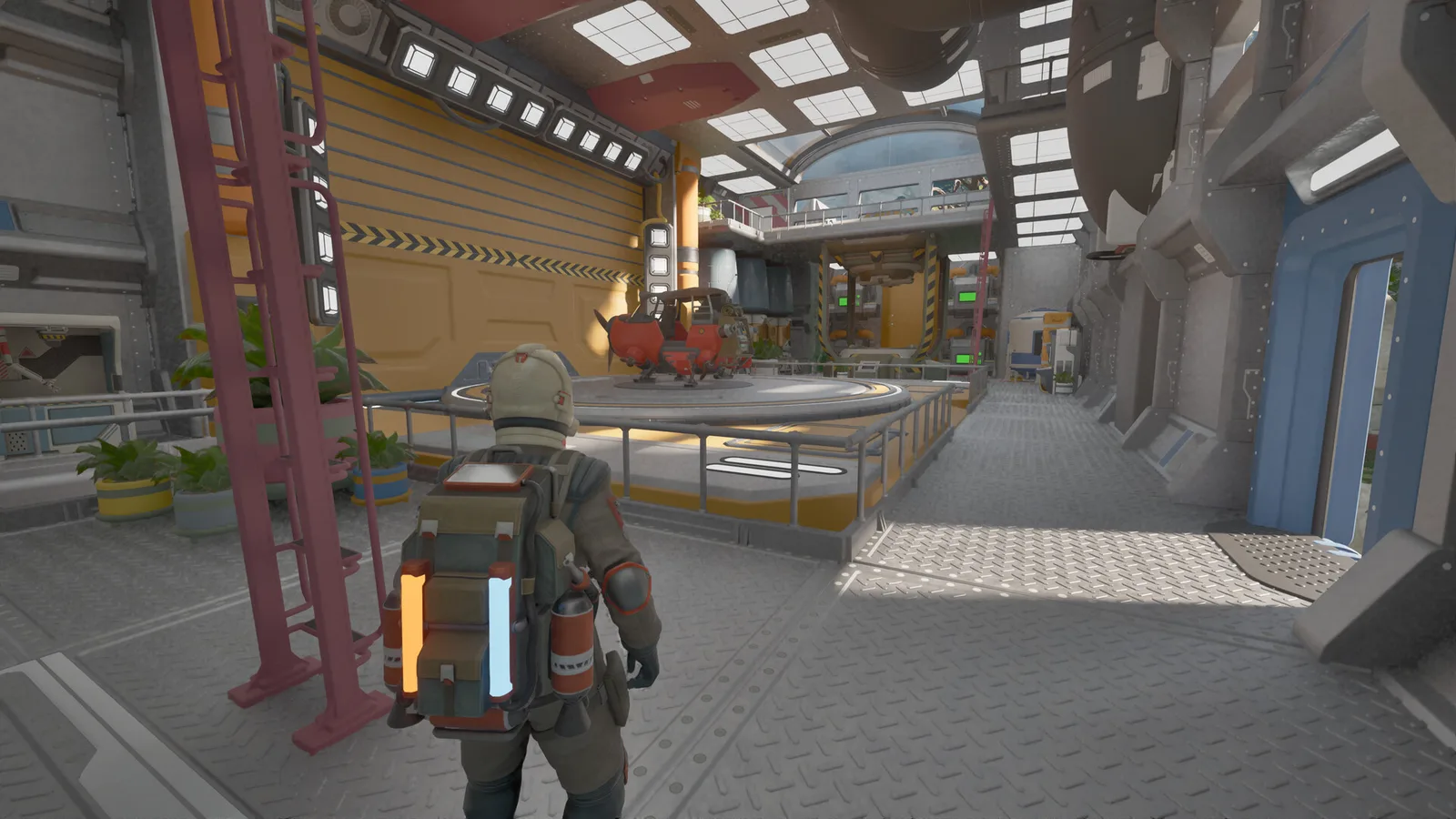
The refinery turns hydrogen crystals into liquid hydrogen. It needs a steady power supply, and the fuel it makes needs cold storage at -253°C, which also needs power. Build the power spine before the refinery, or you will make fuel you cannot keep.
Hydrogen is ATMOSFAR's single fuel chain. Crystals come out of the ground, the refinery converts them, and insulated tanks keep the result liquid long enough to burn. Every step costs either time, cargo space or electricity, and the refinery is where those costs meet.
What the refinery does
- Accepts hydrogen crystals as feedstock.
- Produces liquid hydrogen for Wasp tanks and the Cloud Cruiser's thrust system.
- Draws continuous power while running.
- Produces fuel that must be stored cold; without cooling, it warms and evaporates.
It does not generate power and it does not store fuel. Those are separate modules. A refinery with no tank is a very expensive way to vent hydrogen into the sky.
The three versions of the refinery
| Version | Where it lives | Best for | Main cost |
|---|---|---|---|
| Field refinery | Deployed at a camp or geyser site | Converting at the source, cutting haul distance | Needs camp power; vulnerable to weather |
| Ship refinery | Inside the Cloud Cruiser | High output, safe storage, fleet refuelling | Draws on ship power; needs crystal deliveries |
| Hydrogen siphon | Mounted externally on the ship | Passive top-up from the atmosphere | Low output; constant power draw |
Most established ships run a ship refinery and use a siphon as a trickle feed. Field refineries are for expeditions that range far from the ship.
Power: the number that decides everything
The development blogs use a simple example: a refinery drawing 1 power unit per second, on a ship with a 25 PU reactor. In theory that is 25 refineries. In practice the reactor also powers lift, plant beds, Wasp charging, lights and turrets.
A realistic allocation for a first ship:
- Lift system: the largest single draw.
- Refinery: steady, moderate.
- Wasp charging: spiky, can be deferred.
- Plant beds: steady, small.
- Turrets: bursty, only when something is close.
Keep generation comfortably above idle draw. If the diagnostics unit shows the ship browning out when a Wasp docks, the reactor is too small or the pad is charging too many craft at once.
At a field camp, the arithmetic is harsher. A small battery with 100 units and a refinery at 1 unit per second runs for about a hundred seconds. That is not a fuel operation; that is a demonstration. Field refining needs a real battery bank or a solar array with daylight runs.
Cold storage: the part everyone forgets
Liquid hydrogen is stored at about -253°C. The tanks consume power to stay cold. If the ship or camp loses power:
- The tanks warm.
- The fuel evaporates.
- You lose the fuel and the work that went into it.
Practical consequences:
- Do not build fuel tanks without a power buffer. A battery bank or a second reactor is not optional on a fuel ship.
- Refuel before shutdown. A full tank that stays cold is cheaper than an empty one you refill later.
- Park with the reactor running. If you log off or leave the ship, make sure generation covers cooling.
- Keep the refinery and tanks close. Fewer hull sections between them means fewer things to repair.
Refinery vs siphon
| Question | Refinery | Siphon |
|---|---|---|
| Output | High, limited by crystal supply | Low but continuous |
| Input | Hydrogen crystals | Atmosphere |
| Power | Moderate while running | Constant |
| Logistics | Needs mining and hauling | Needs nothing but power |
| Best use | Filling tanks before a long trip | Keeping tanks from emptying while parked |
A pure siphon ship is possible but slow. A pure refinery ship is fast but depends on crystal runs. The comfortable middle is a refinery for bulk and a siphon for idle top-up.
Setting up a field refinery
- Pick a site near a geyser but upwind of the vent.
- Deploy the Camp Hub and confirm battery charge.
- Place the refinery on flat ground with room to access it.
- Add a tank — without one, the output has nowhere to go.
- Run in daylight if you rely on solar; shut down at night unless you have battery headroom.
- Pack the fuel, not the crystal. Carry liquid hydrogen back to the ship.
A field refinery is also a forward refuelling point for Wasps working a distant wreck field. That is its best use: shorten the round trip, not replace the ship.
Troubleshooting
| Symptom | Cause | Fix |
|---|---|---|
| Refinery runs but no fuel appears | No storage tank, or tank full | Add tank capacity or burn fuel |
| Fuel level drops while parked | Tank cooling lost power | Restore generation; check reactor fuel |
| Refinery stops intermittently | Power draw exceeds supply | Add battery buffer or shut down other modules |
| Fuel disappears after a storm | Hull/tank damage or power outage | Repair with welder; check diagnostics |
| Ship cannot take off after refuelling | Weight increased and lift did not | Add balloon volume or offload cargo |
How much fuel is enough?
Plan by mission, not by gauge:
- Local scrap run: full Wasp tank, one reserve canister if you carry one.
- Region crossing: full tanks on every craft, plus ship tanks above half.
- Ship relocation: full ship tanks and a refinery that can run during the trip; do not rely on siphon output alone.
If you are routinely arriving with less than a quarter tank, your route is too long or your ship is too heavy. Fix the cause, not the gauge.
Early Access footage from Tycos. Screenshots: Apog Labs / SHUEISHA GAMES.
FAQ
Can the refinery make fuel from water? No documented water-to-fuel path. The feedstock is hydrogen crystals.
Does the siphon replace mining? It reduces it. Siphon output is low; bulk fuel still comes from crystals.
Can I refine on a Wasp? No. Refining happens at a field refinery, a camp, or the Cloud Cruiser.
What happens if liquid hydrogen warms up? It evaporates and is lost. Keep tank cooling powered.
Is there a maximum tank size? Not documented. The practical limits are weight, hull space and the power needed to keep the fuel cold.
Sources
- ATMOSFAR on Steam — store description, system requirements and Early Access notes.
- ATMOSFAR Steam news hub — patch notes and developer posts.
- ATMOSFAR official site — Apog Labs announcements and media.
Related reading: ATMOSFAR Hydrogen Crystals: Where to Find and How to Use and ATMOSFAR Cloud Cruiser Guide: Build, Power and Modules.
Source note: mechanics and figures in this guide follow the Early Access build available on 30 October 2026, cross-checked against the ATMOSFAR Steam page and Apog Labs developer posts.
More ATMOSFAR Guides
Is ATMOSFAR coming to PS5 or Xbox? The current console status, why Early Access is PC-only, what a port needs and where official news appears.
How crafting works in ATMOSFAR: crafting table, research desk unlocks, blueprint sources, material processing and the order to build tools and ship parts.
The animals, plantimals and machines that end ATMOSFAR runs: Screechers, Blisterbacks, Traproots, PACE drones and AA turrets, with counters for each.
The ATMOSFAR Early Access roadmap: Vagabond, Rime, Blue Side and Singularity updates, the Scout Wasp, the third region, 1.0 timing and launch content.
How the ATMOSFAR map works: the floating layers of Tycos, where Caligo Cays sits, what Early Access includes and how to navigate without a full map.
ATMOSFAR released on 29 October 2026 in Steam Early Access at $24.99, with a 10% launch discount to $22.49. Platforms, editions and what comes next.
A practical map of ATMOSFAR resources: scrap, circuit boards, hydrogen crystals, wood, food, water, artefacts and cores, with where to look for each.
An honest ATMOSFAR Early Access review: ship-building is excellent, the survival loop is coherent, and the launch build is still rough. Buy or wait?