
ATMOSFAR Airship Building: Hull, Lift and Weight
Build a flyable ATMOSFAR airship: how hulls, hydrogen balloons, lift, thrust and power interact, plus three starter layouts that stay under the weight limit.
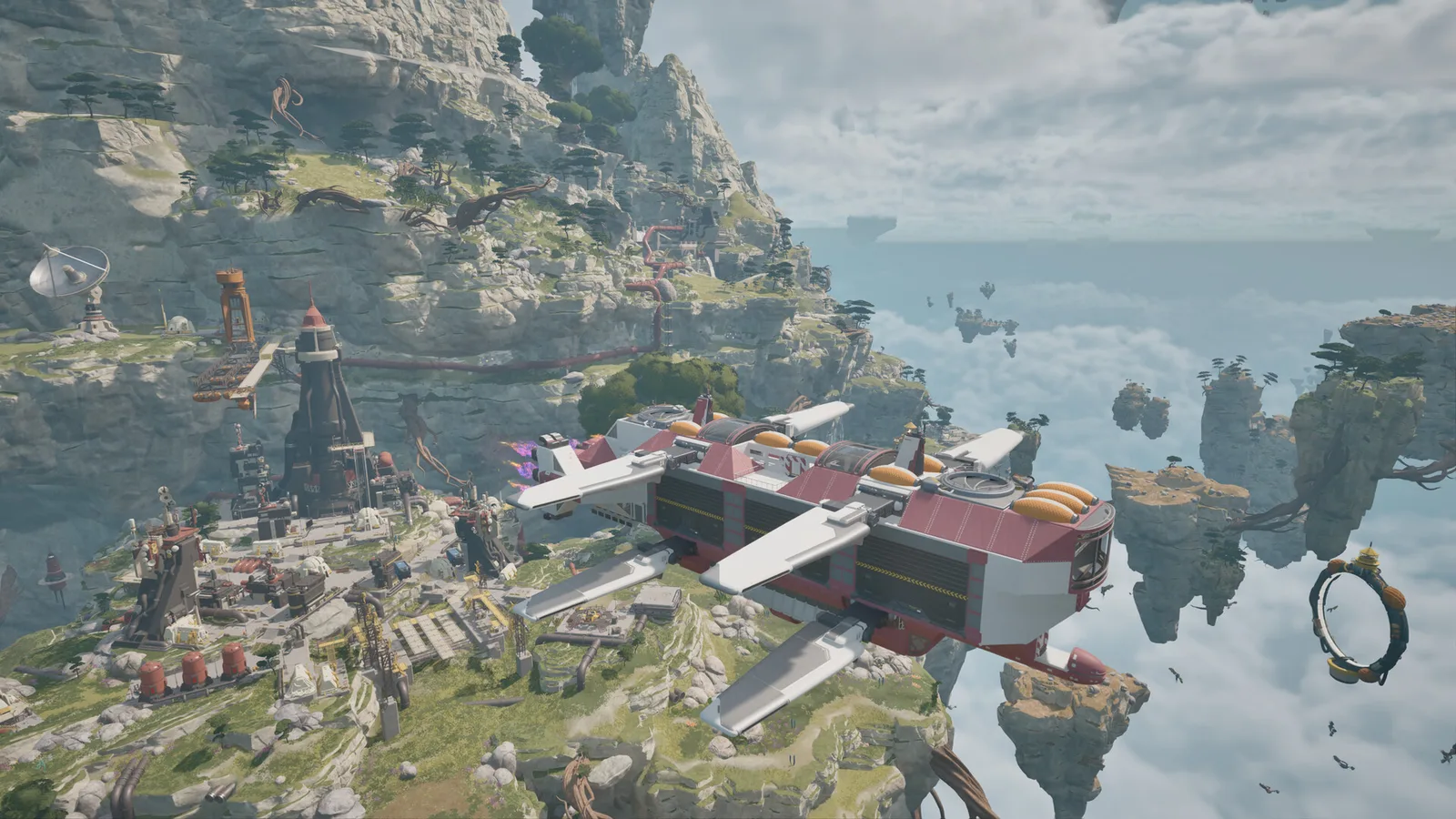
An airship flies when lift from hydrogen balloons is greater than weight from hull, modules and cargo, and when power generation is greater than power draw. Thrust only decides where you go. Build the lift and power spine first, then wrap a hull around it.
ATMOSFAR's building system is permissive enough to let you make almost any shape, which is exactly why so many first ships do not fly well. There is no blueprint and no correct silhouette. There is only a set of physical budgets the ship has to satisfy.
The four numbers behind every airship
| Number | Produced by | Spent by | Failure symptom |
|---|---|---|---|
| Lift | Hydrogen balloons / balloon volume | Hull, armour, furniture, cargo, Wasps | Overweight warning, sluggish climb, low ceiling |
| Weight | Every part you place | Lift capacity | Same as above |
| Power (PU/s) | Nuclear reactor cores | Lift systems, refinery, plant beds, charging, turrets | Modules brown out, fuel warms, ship cannot hold altitude |
| Thrust | Engines and liquid hydrogen | Manoeuvring and travel | Slow turns, inability to fight wind, short range |
The order of operations is: balloons → reactor → hull → modules → cargo. If you reverse it, you will spend an hour decorating a ship that cannot leave the dock.
Hull parts: shape is free, mass is not
Hull parts come in different shapes and can be tinted individually. You can build a long cargo barge, a squat workshop or something that looks like a flying village. Two rules survive all that freedom:
- Every part has weight. A decorative tail fin still counts. Check the diagnostics unit or the build UI after large additions.
- Hull shape affects landing. A long nose is harder to put down on a small islet. If you plan to camp on fragments, keep the footprint compact.
Interior pieces — walls, windows, doors, railings, ladders, stairs — are lighter than structural hull but not weightless. A multi-deck interior needs corresponding lift and power.
Lift: balloons are the real engine
The ship floats because of hydrogen-filled balloons. The siphon feeds them; the balloon count and volume set the ceiling.
- More balloons mean more lift, but they also add drag and structure.
- Balloons are the first thing to expand when you add a workshop, a second Wasp pad or armour.
- Lift is not free: maintaining it draws power. A ship with enormous balloon volume and a small reactor will sag the moment the reactor is loaded.
If the ship is overweight, the game warns you. The correct response is to add balloon volume or remove mass. Pulling back on the throttle does nothing.
Thrust and manoeuvring
Thrust comes from the engine system and burns liquid hydrogen. The helm controls forward, reverse and turning. A few handling truths from the dev blogs:
- The Cloud Cruiser is heavy and turns slowly. Plan wide approaches.
- Cruise control and the periscope let you mark a waypoint and let the ship run, which is easier than holding a heading for ten minutes.
- Wind and weather push a large hull around. A storm is not the time to thread a canyon.
Smaller Wasps are the opposite: agile, quick to accelerate and happy to hover. Use them for precision work and keep the big ship for distance.
Power: size the reactor before the workshop
The reactor produces power units per second. Every powered module draws from that pool. The development example is a 25 PU reactor running a refinery at 1 PU — theoretically 25 refineries, practically far fewer once lift, charging and plant beds are counted.
A useful habit is to write down the draw of every always-on module and keep generation at roughly double the idle load. That headroom covers turret bursts, Wasp charging and the extra lift needed when you load cargo.
If you add a second reactor, you need a second core. Cores are rare, heavy and radioactive, and they must be hauled with the Hauler. Do not treat a second reactor as a routine upgrade.
Fuel systems: refinery or siphon
There are two ways to keep liquid hydrogen in the tanks:
- Refinery: consumes hydrogen crystals hauled from the surface, produces fuel at high output. Requires a supply line and cargo space.
- Siphon: pulls hydrogen from the atmosphere, lower output, but needs no crystal runs. Requires continuous power.
Most workable ships carry a refinery and use a siphon as a top-up. Fuel tanks must stay cold; if the ship loses power for long, the fuel evaporates. That is the strongest argument for keeping a dedicated battery bank or a second small reactor.
Three starter layouts that work
1. The workshop barge
Compact hull, one reactor, one refinery, one material processor, one Wasp pad, no decoration. It is ugly, cheap and flies. Use it to process large wrecks and move your camp between islands.
2. The expedition ship
Medium hull, reactor plus a battery bank, refinery and siphon, two Wasp pads, plant beds, diagnostics unit. Enough range for a region crossing and enough food to stay out for several sessions.
3. The mobile camp
Small hull, minimal power, one pad, a plant bed and a lounge. It follows a ground camp rather than replacing it. Best for solo players who want a safe logout point and a way to move a Utility Wasp without a long flight.
All three share the same discipline: lift first, power second, decoration last.
Building with friends
While you are shaping the ship, your jetpack plugs into the Cruiser's fuel reserves and can hover indefinitely. Multiple players can be plugged in at once, so a four-person crew can build a hull section in parallel.
Practical co-op rules:
- Agree on the layout before placing hull parts. Moving a wall is cheap; rebuilding a power spine is not.
- Give every player a room or bunk. The game's own blog recommends it, half-jokingly.
- One player should own the diagnostics check before every flight. Shared ships fail when everyone assumes someone else checked the fuel.
Common build failures
| Symptom | Likely cause | Fix |
|---|---|---|
| Overweight warning on take-off | Too much hull/armour/cargo for balloon volume | Add balloons or remove mass |
| Climbs but cannot hold altitude | Power draw exceeds generation | Add reactor capacity or shut down modules |
| Fuel disappears while parked | Tanks lost cooling power | Charge batteries, add reactor headroom |
| Modules switch off in bursts | Turrets or charging spiking the load | Add battery buffer, stagger turret use |
| Cannot turn in a canyon | Too much mass and wind | Approach from open sky, use a Wasp for the final leg |

Early Access footage from Tycos. Screenshots: Apog Labs / SHUEISHA GAMES.
FAQ
Do I need a reactor to fly? Yes for a full Cloud Cruiser. Lift and modules draw power; without a reactor you are relying on stored charge, which is temporary.
Can I build a ship with no weapons? Yes. Turrets are defensive and optional. If you park near PACE sites, bring at least one stun turret or approach on foot.
Are there blueprints for the hull? No fixed blueprints. Hull parts are placed freely and tinted individually. The "blueprints" you find in scrap are for craftables and knowledge, not a required ship shape.
How big can a ship get? There is no hard limit described; the limit is practical: enough reactor cores for lift and enough fuel to move the mass. Most players hit the power and core bottleneck long before a size cap.
Sources
- ATMOSFAR on Steam — store description, system requirements and Early Access notes.
- ATMOSFAR Steam news hub — patch notes and developer posts.
- ATMOSFAR official site — Apog Labs announcements and media.
Related reading: ATMOSFAR Cloud Cruiser Guide: Build, Power and Modules and ATMOSFAR Hydrogen Refinery Guide: Fuel From Crystal.
Source note: mechanics and figures in this guide follow the Early Access build available on 30 October 2026, cross-checked against the ATMOSFAR Steam page and Apog Labs developer posts.
More ATMOSFAR Guides
The animals, plantimals and machines that end ATMOSFAR runs: Screechers, Blisterbacks, Traproots, PACE drones and AA turrets, with counters for each.
The ATMOSFAR Early Access roadmap: Vagabond, Rime, Blue Side and Singularity updates, the Scout Wasp, the third region, 1.0 timing and launch content.
Find ATMOSFAR hydrogen crystals near geysers, harvest them safely, haul them with the Hauler and turn them into liquid hydrogen before your Wasp runs dry.
Run an ATMOSFAR hydrogen refinery without draining your camp: power draw, cold storage at -253°C, field vs ship refining, siphon top-ups and common failures.
How the ATMOSFAR map works: the floating layers of Tycos, where Caligo Cays sits, what Early Access includes and how to navigate without a full map.
ATMOSFAR released on 29 October 2026 in Steam Early Access at $24.99, with a 10% launch discount to $22.49. Platforms, editions and what comes next.
A practical map of ATMOSFAR resources: scrap, circuit boards, hydrogen crystals, wood, food, water, artefacts and cores, with where to look for each.
An honest ATMOSFAR Early Access review: ship-building is excellent, the survival loop is coherent, and the launch build is still rough. Buy or wait?