
ATMOSFAR Gameplay: The Core Loop Explained
How ATMOSFAR actually plays: the scrap-and-fuel loop, the three Wasp classes, camp power, Cloud Cruiser upgrades, co-op and the limits of Early Access.
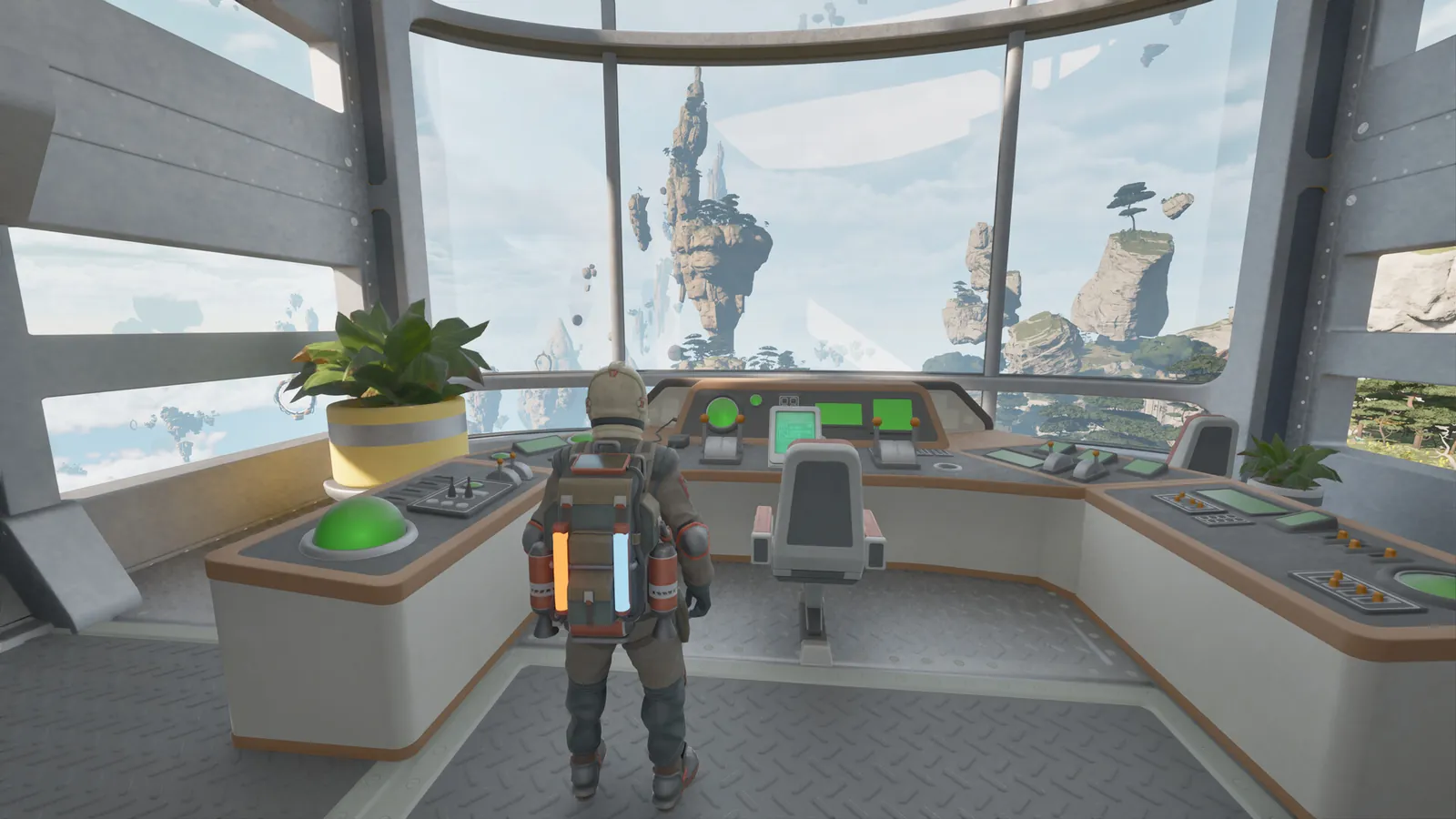
The short answer: ATMOSFAR is a first-person survival-adventure on floating islands. You fly a small craft called a Wasp, strip wreckage with an extractor, haul scrap home, keep your camp powered, and pour the proceeds into a large airship called the Cloud Cruiser. The loop is fly out → extract → return → craft and refuel → fly farther. Combat is light, survival pressure comes from power and fuel, and co-op is online.
That is the loop in one paragraph. The rest of this page explains how each part feeds the next, and where Early Access currently stops.
The loop, step by step
- Scout a wreck or island. You leave camp with a charged backpack and a fueled Wasp.
- Extract materials. The extractor breaks scrap into usable components. Large pieces refuse to break until you have the right tool or vehicle.
- Haul it back. Cargo space is the real constraint early on; the Hauler Wasp exists for this reason.
- Craft and power. Scrap becomes building parts, fuel, and research materials. The Camp Hub powers every device in range.
- Upgrade the ship. The Cloud Cruiser is the long-term project: storage, crafting, reactor, and the range to reach new regions.
- Repeat with a longer radius. Each upgrade buys distance, and distance is where the better wrecks are.
The failure state is almost always the same: you fly too far, your backpack life support or hydrogen runs dry, and you cannot get home. The beginner guide is built around avoiding exactly that in the first two hours.
The three Wasp classes
Wasps are not cosmetic mounts. Each class changes what a trip can accomplish.
| Class | Role | Strength | Limitation |
|---|---|---|---|
| Utility Wasp | Mobile camp | Carries the Camp Hub, generates power, recharges gear | Small tank, thirsty, slow |
| Hauler Wasp | Heavy lift | Magnetic crane, multiple cargo slots, moves large scrap | Slow and fuel-hungry |
| Striker Wasp | Combat | Fastest acceleration, turret with multiple projectile types | Fragile, no cargo focus |
A fourth craft, the Scout Wasp, is listed for the Rime update and is not in the launch build. Until it arrives, scouting is done by eye and with the spotting scope. The Wasp guide covers handling and loadouts per class.
Camp power is the real survival system
ATMOSFAR does not use a hunger bar as its main pressure. It uses electricity and fuel:
- Your backpack runs life support and tools, and it drains while you are away from camp.
- The Wasp runs on liquid hydrogen, which you refine rather than pick up ready-made.
- Camp devices only work inside the Camp Hub's power radius.
That makes the Camp Hub the most important early build, and it is why the Utility Wasp matters before any combat upgrade. A base without power is a storage box. The hydrogen refinery page explains the fuel chain; the camp hub page covers placement and power radius.
Watch backpack charge and Wasp hydrogen together. It is easy to fixate on one, fly home on the other, and stall short of the pad.
The Cloud Cruiser is the progression spine
The Cloud Cruiser is a large airship that acts as a mobile base. Early on it is a workshop and storage; later it is how you reach regions that a Wasp cannot. Its reactor is also an objective chain: reactor cores must be found, transported, and installed, and several launch-week patches were specifically about cores getting stuck or failing to respawn.
Two practical notes from the current build:
- Crafting pulls from trunks as of patch 1.0-7, so you no longer need to carry every material to the bench.
- Reactor cores can be deconstructed after insertion as of 1.0-11, which fixes a common trap.
The Cloud Cruiser guide covers the upgrade order and the reactor chain in detail.
Combat, danger and PACE
Combat exists but is not the focus. The Striker Wasp carries a turret, and on foot you have tools rather than a shooter's arsenal. The main hostile force is PACE, a security presence with bases and frequencies you can tune into with the spotting scope. Some areas are guarded; some wrecks sit inside anti-air coverage.
The practical rule: fight when a wreck is worth it, and leave when the fuel math says you cannot. The PACE bases page covers frequency scanning and base layouts.
Co-op: what sharing actually looks like
ATMOSFAR supports online co-op — Steam lists Online Co-op, and the official material describes assembling a squadron of friends. In practice, co-op means:
- One crew, one shared camp and ship effort.
- Roles split naturally by Wasp class: one player hauls, one builds, one flies cover.
- Progress is collective, so a session where only one player extracts still moves the group forward.
There is no offline co-op and no split-screen. The co-op guide covers crew roles and the mistakes that sink runs.
What ATMOSFAR is not
Set expectations correctly before buying:
- Not a shooter. Weapons exist, but the game is about extraction and logistics.
- Not a full release. Early Access is planned for roughly 9–12 months, and systems are still changing weekly.
- Not a console game. PC only, with no PS5, Xbox or Switch 2 version announced.
- Not PvP. Steam lists single-player and online co-op, not PvP.
If you want a finished, balanced campaign, waiting for 1.0 is reasonable. If you enjoy a loop that is being actively tuned — eight builds in nine days — the current build is stable enough to learn.
How the loop changes over time
The early game is short trips around Pearl Island. The mid game is the Cloud Cruiser and the second region. The late game is reactor logistics and guarded wrecks in weather that punishes a long flight. The roadmap page lists the planned regions and updates, and the review roundup covers how the current build is being received.
FAQ
What do you do in ATMOSFAR? You salvage floating wrecks, keep a camp powered, upgrade an airship and push into new regions.
Is ATMOSFAR a combat game? Only partly. Combat is light; the core is extraction, fuel and base logistics.
How many players in co-op? Online co-op is supported; the game is built around a small squadron rather than a large server.
Is there PvP? No. Steam lists single-player and online co-op.
Does ATMOSFAR have an ending? Not yet — it is in Early Access, with 1.0 planned after roughly 9–12 months.
Official source: ATMOSFAR on Steam Official source: ATMOSFAR Steam news hub Official source: Apog Labs
More ATMOSFAR Guides
How ATMOSFAR multiplayer works: four-player online co-op, crew roles, sharing the Cloud Cruiser, keeping camp running and mistakes that sink runs.
Is ATMOSFAR coming to PS5 or Xbox? The current console status, why Early Access is PC-only, what a port needs and where official news appears.
How cooking and food fit into ATMOSFAR's survival loop: where organic ingredients come from, how to stock a camp, and what is confirmed.
How crafting works in ATMOSFAR: crafting table, research desk unlocks, blueprint sources, material processing and the order to build tools and ship parts.
The animals, plantimals and machines that end ATMOSFAR runs: Screechers, Blisterbacks, Traproots, PACE drones and AA turrets, with counters for each.
ATMOSFAR has no crossplay in 2026: it is a PC-only Steam release. What that means for four-player co-op, consoles and a future crossplay patch.
The Atmosfar demo was delisted months before launch. What it covered, why it is gone, and a walkthrough of the same opening beats in the Early Access build.
The ATMOSFAR Early Access roadmap: Vagabond, Rime, Blue Side and Singularity updates, the Scout Wasp, the third region and the 20 November dev blog.