
ATMOSFAR Jetpack Guide (2026): Fuel, Upgrades and Limits
How the ATMOSFAR jetpack works: atmospheric hydrogen refuelling, short flights, upgrades, the Cloud Cruiser build hose and why it cannot replace a Wasp.
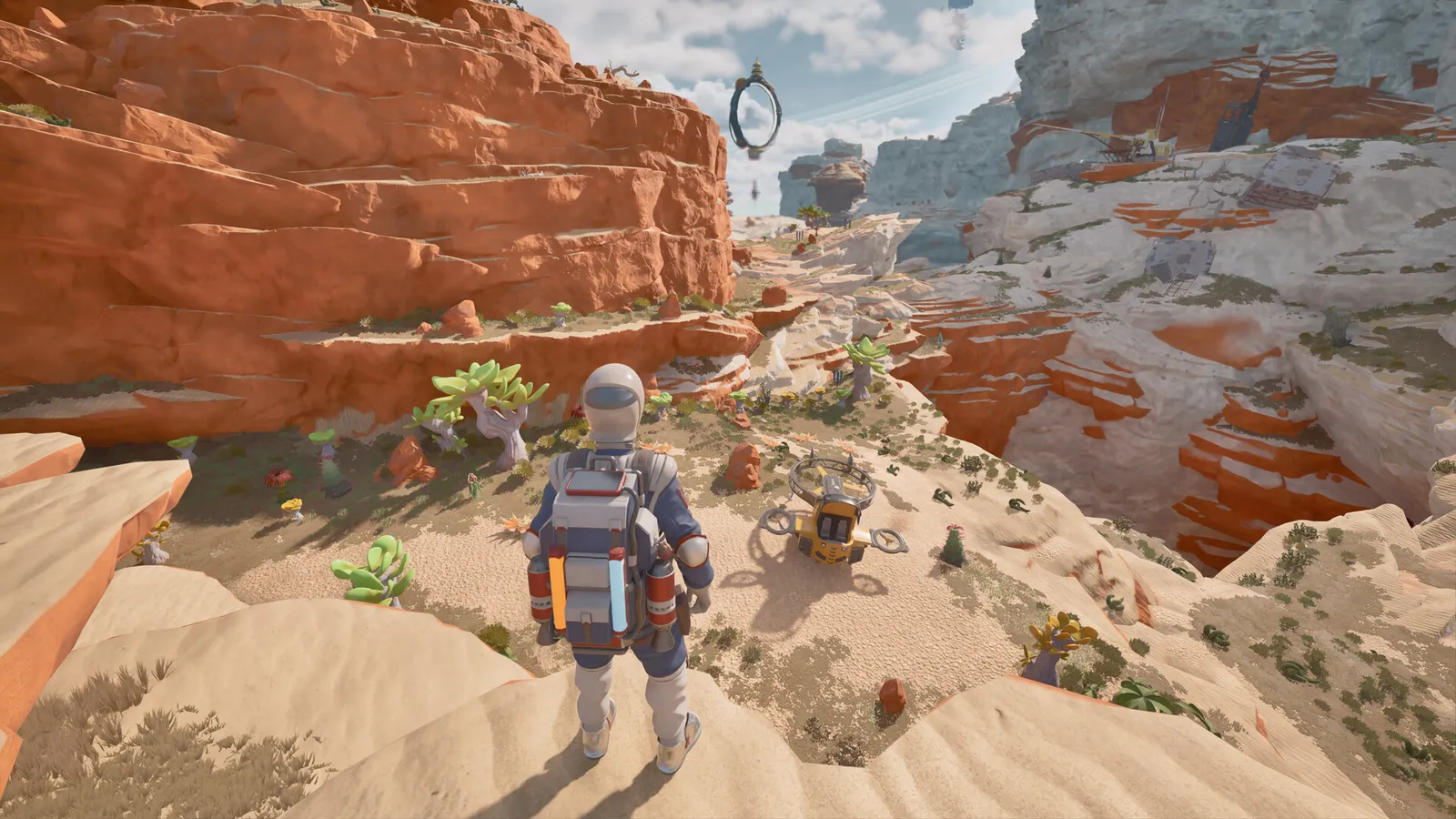
Quick answer: Every Vagabond in ATMOSFAR carries a jetpack built into the backpack. It burns liquid hydrogen, regenerates its own fuel by pulling hydrogen gas out of the atmosphere, and is designed for short flights rather than long-distance travel. You can upgrade it for longer airtime, and you can plug it into the Cloud Cruiser's fuel reserves to hover indefinitely while building.
What the jetpack actually is
The jetpack is not a separate vehicle or a late-game unlock. Apog Labs describes it as part of the standard backpack in Dev Blog 6, "Life of a Vagabond". The same backpack carries your life-support system, a small solar panel, a reserve fuel container for the Wasp and the jetpack itself.
That matters for planning: you always have it, and it always shares the suit's physical limits. It is the tool that lets you cross a gap, reach a ledge or reposition around a wreck without going back for a Wasp. It is not the tool that replaces the Wasp for travel between islands.
The official store description does not list the jetpack as a headline feature, so most of what is known comes from the developer blogs rather than the Steam page. That is still official information, but it means there is no published stat sheet for flight time, thrust or upgrade tiers.
How the fuel system works
The jetpack runs on liquid hydrogen, the same fuel as every Wasp class. Its difference is how it refills: a fuel-regeneration device converts hydrogen gas present in the atmosphere into liquid hydrogen and stores it in the jetpack's internal tank.
The jetpack regenerates while you walk. Short bursts separated by a few steps go much further than one continuous burn.
In practice:
- It refills itself. You do not need to dock or refuel it by hand for normal use.
- Regeneration is slow relative to flight. The jetpack can only sustain shorter flights before you need to let it recover.
- It is not infinite. Hovering constantly will drain it faster than the atmosphere can refill it.
- Upgrades extend airtime. The developer blog says you can upgrade the jetpack to keep you in the air for longer, using skills and materials.
The exact regeneration rate and tank size are not officially published. Any page quoting a precise number of seconds is guessing or measuring a specific build, not reading a spec sheet.
[!guide] atmosfar-hydrogen-crystals The jetpack shares the hydrogen economy with your Wasps; the crystal guide covers where the fuel chain starts.
Jetpack vs Wasp: which one to use
| Job | Jetpack | Wasp |
|---|---|---|
| Crossing a gap on foot | Yes | Overkill |
| Reaching a ledge or roof | Yes | Often impossible to land |
| Travelling between islands | No | Yes |
| Carrying scrap | No | Yes |
| Combat | No | Striker has a turret |
| Building the Cloud Cruiser | Yes, with the fuel hose | Not the intended tool |
The rule is simple: the jetpack is for the last hundred metres, the Wasp is for the first ten kilometres. Using the jetpack as a main engine is the mistake the beginner guide warns about, because you will run out of lift over open sky with no camp to recharge at.
The Cloud Cruiser build hose
This is the jetpack's best trick. When you enter build mode around the Cloud Cruiser, the jetpack automatically taps into the ship's fuel reserves through a long hose. While connected, you can stay airborne indefinitely and build the hull from the outside.
The official Dev Blog 10, "Cloud Cruiser 101", describes it directly: the hose means you do not have to worry about running out of fuel while constructing, and the ship supports multiple jetpacks plugged in at the same time. A four-person crew can all hover around the hull and build in parallel.
Two practical consequences:
- Build the outside first, then the interior. The hose makes exterior work cheap; interior work does not need it.
- Keep the ship fuelled before a build session. The hose draws from the Cruiser's reserves, so a dry ship grounds the whole crew.
The airship building guide covers hull, lift and weight, and the Cloud Cruiser guide covers the modules that make the ship work.
Upgrading the jetpack
The only official statement is that the jetpack can be upgraded to stay in the air longer, using skills and materials. The game does not publish a tier list, and the developer blogs do not give costs.
What that means for planning:
- Treat the jetpack upgrade as a quality-of-life purchase, not a progression gate.
- Do it after your camp power, fuel loop and Wasp are stable.
- Do not strip a working Wasp for jetpack materials; the Wasp is the vehicle that actually moves your economy.
- Check the crafting and research menus after each patch, because upgrade recipes can change during Early Access.
The crafting guide covers the research chain, and the research guide explains how artefacts unlock recipes.
Five ways to use it well
- Climb before you cross. A short jetpack boost at the start of a gap is worth more than a long burn in the middle.
- Use it to scout a landing zone. Hover above a ridge, check the slope, then bring the Wasp down.
- Chain short hops. Let the tank regenerate while you walk; do not hold the thrust key for the whole traverse.
- Build with the hose, not against it. If you are shaping the Cruiser, stay connected and work in one long session.
- Keep a reserve for the return. The jetpack refills slowly; do not spend the last of it on a view.
What the jetpack cannot do
It cannot carry cargo. It cannot fight. It cannot cross an ocean of sky. It cannot replace a Wasp pad on the Cloud Cruiser, and it does not make fall damage irrelevant.
It also does not have an officially documented control scheme beyond the standard movement bindings. Patch 1.0-10 added keybind options, so if the default thrust key feels wrong, check the settings menu rather than assuming the jetpack is broken.
About ATMOSFAR (2026)
ATMOSFAR is an open-world co-op survival game from Apog Labs, published by SHUEISHA GAMES. It entered Steam Early Access on 29 October 2026 at $24.99 with a 10% launch discount, and supports solo or four-player online co-op.
The Steam store page is the official feature list. The Steam news hub hosts Dev Blogs 6, 10 and 18, which describe the jetpack, its fuel regeneration and the Cloud Cruiser hose. The official site carries the studio's announcements.
Official source: ATMOSFAR on Steam
FAQ
Does ATMOSFAR have a jetpack? Yes. It is built into the backpack and available from the start of the Early Access build.
How does the jetpack refuel? It converts hydrogen gas from the atmosphere into liquid hydrogen and stores it internally. It does not need a manual refuel for normal use.
Can the jetpack fly forever? No. It sustains short flights and regenerates slowly. Plugging into the Cloud Cruiser's fuel hose allows indefinite hovering while building.
Can you upgrade the jetpack? Yes, according to the developer blog. Upgrades extend airtime; the exact costs are not officially published.
Is the jetpack better than a Wasp? No. It is for short hops and building; the Wasp is for travel, cargo and combat.
Why does the jetpack stop working? It is probably out of fuel and regenerating. Land, wait for the tank to refill and avoid holding thrust continuously.
[!next] Movement Guides
- Beginner Guide: The first camp and fuel loop.
- Cloud Cruiser: Where the build hose plugs in.
- Wasp Guide: The vehicle the jetpack does not replace.
More ATMOSFAR Guides
How ATMOSFAR multiplayer works: four-player online co-op, crew roles, sharing the Cloud Cruiser, keeping camp running and mistakes that sink runs.
Is ATMOSFAR coming to PS5 or Xbox? The current console status, why Early Access is PC-only, what a port needs and where official news appears.
How cooking and food fit into ATMOSFAR's survival loop: where organic ingredients come from, how to stock a camp, and what is confirmed.
How crafting works in ATMOSFAR: crafting table, research desk unlocks, blueprint sources, material processing and the order to build tools and ship parts.
The animals, plantimals and machines that end ATMOSFAR runs: Screechers, Blisterbacks, Traproots, PACE drones and AA turrets, with counters for each.
ATMOSFAR has no crossplay in 2026: it is a PC-only Steam release. What that means for four-player co-op, consoles and a future crossplay patch.
The Atmosfar demo was delisted months before launch. What it covered, why it is gone, and a walkthrough of the same opening beats in the Early Access build.
The ATMOSFAR Early Access roadmap: Vagabond, Rime, Blue Side and Singularity updates, the Scout Wasp, the third region and the 20 November dev blog.